
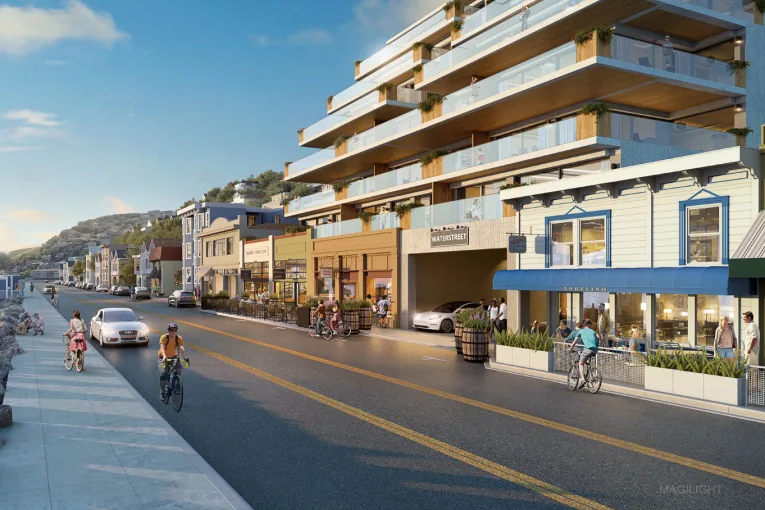
It may be the clearest sign yet that California’s aggressive housing mandates, lawsuits and enforcement tools are beginning to work. The traditionally anti-growth city of Sausalito — in the heart of deeply anti-growth Marin County — just voted overwhelmingly to approve zoning changes allowing dense housing development along Bridgeway, and additional affordable senior units. For decades, Marin symbolized resistance to state housing policy, regional planning and compliance with RHNA. Now, voters themselves are opening the door.
Measure J, which rezones roughly 16 acres to allow between 415 and 530 new homes, is winning with about 75 percent of the vote. Measure K, which allows 50 affordable senior units at Martin Luther King Jr. Park, is passing with around 55 percent support. These are numbers no one would have predicted even recently in a city that permitted only 58 new homes from 2015 to 2022.
Developer Dan Morgan said the results defy decades of political history. “I have been in Sausalito since the early ’80s, and my observation is everything in Sausalito is always about 50/50 and is always a big fight,” he said. “I have never seen anything pass with 65% or 70%.”
Architect Michael Rex supported both measures and believes the shift is necessary.
“Every community needs a mix of housing values, because when you have a mix of housing values you have a mix of people, and with a mix of people you have a mix of ideas rather than a mono class,” he said. “It’s a healthier community.”
But not everyone sees the vote as progress.
Property owner Linda Fotsch said the rezoning strategically avoids wealthier neighborhoods.
“I think this was a ‘not in my backyard’ movement to move everything out of the southern side of town where people have money and stick it all down there right next to each other,” she said.
Cushman & Wakefield Managing Principal Whitney Strotz said decades of stagnation made change inevitable.
“We were so ‘no growth’ in the North Bay for so long, we got behind and we didn’t create the variety of housing stock that a healthy community needs,” he said. “We stunted ourselves for so long, and now we are going to have some teenage pimples popping up.”
Even critics acknowledge the political reality: once the state began enforcing housing law, the ground shifted. Many cities that spent years resisting compliance are now facing builder’s remedy projects, litigation and the loss of local discretion — the very outcome they hoped to prevent.
Land use attorney Ryan Patterson said the backlash created the current situation.
“The irony of what the city has done here is they have pushed all of their planned development into a few sites, which means they are going to have towers in Sausalito,” he said. “The thing they have tried so hard to avoid is the thing they ended up doing to themselves.”
This shift isn’t isolated. Santa Cruz voters also approved a pro-housing measure this month. And in Southern California, La Cañada Flintridge abruptly ended its high-profile legal challenge against a builder’s remedy project after a judge ordered the city to post a $14 million bond to continue the appeal. Rather than risk the consequences, the city allowed the project to move forward.
These moments reflect something larger: the housing politics of California are changing.
The economics are changing too.
Ger’rell King, Director of Land Acquisition and author of a recent development analysis, wrote that first-time buyers now represent only 21 to 24 percent of purchasers, down from 32 percent two years ago, and their median age has risen to between 38 and 40.
He wrote that “over 60% of prospective buyers are expressing interest in modular and smaller homes as pathways to affordability,” arguing that developers still building traditional single-family starter homes are designing for a market that barely exists anymore.
For Davis, all of this carries direct implications.
Davis has been wrestling with housing decisions under Measure J/R/D for twenty-four years, with every major subdivision placed on a ballot and subject to election outcomes rather than normal planning processes.
While cities like Sausalito, Santa Cruz and La Cañada Flintridge are bending under state pressure, Davis remains locked in voter-controlled land-use decisions — a structure that has so far produced limited housing growth and shrinking school enrollment.
The same pressures now reshaping Marin could soon reach Davis.
The state has already signaled it is willing to intervene where jurisdictions block required housing capacity, and the housing element battles emerging statewide are beginning to resemble the pattern seen with CEQA reform: first ignored, then resisted, then enforced.
The parallels are unavoidable. Marin — the poster child of obstruction — is now rezoning land before Davis has approved anything comparable. And unlike Davis, Sausalito’s change wasn’t forced through litigation or state override. Voters approved it.
If Marin County is shifting, it raises the question: how long can Davis stand alone?
Davis is currently debating housing proposals including Village Farms and Willowgrove, projects that could address some of the housing shortages driving declining enrollment and affordability challenges. The question now is whether Davis interprets statewide momentum as a warning — or waits until the state removes local discretion entirely, as it has begun doing elsewhere.
Across California, the message from voters, courts and market forces is becoming harder to ignore: housing resistance is no longer politically sustainable.
Whether Davis changes voluntarily or by mandate remains to be seen.
Follow the Vanguard on Social Media – X, Instagram and Facebook. Subscribe the Vanguard News letters. To make a tax-deductible donation, please visit davisvanguard.org/donate or give directly through ActBlue. Your support will ensure that the vital work of the Vanguard continues.

Well there goes Sausalito.
Why do Democrats destroy everything they get their hands on?
yeah, the cool parts of Sausilito that visitors can enjoy is not where the wealthy live, it’s the commercial area that is going to housing. So a combination of YIMBY backed by rich developer pressure, and manipulated by rich locals who want . As it any of this is going to really be “affordable” in any real sense. This is all about profit and protection.
Sausalito is not expanding their boundaries onto farmland outside of city limits. No comparison whatsoever to Measure J, urban growth boundaries, etc.
But yes, I also read that one of the reasons that the rezoning of some commercial sites for housing was due to a desire to keep such development away from the wealthier parts of town. Apparently, Sausalito made that choice voluntarily, in hopes of satisfying fake housing “requirements”.
In fact, I don’t believe that Davis even has the type of “within city” restrictions that Sausalito had in the first place. In other words, the Davis council alone can make the type of minor changes for which Sausalito required a vote of their own residents.
As a result of the vote, the property below is apparently being rezoned for up to 50 units of Affordable housing for seniors – you can see a photo of it in the article. (I wonder what the source of money is, to build these units?)
“At the park Tuesday, Patrick Ward, vice chair of the Sausalito Parks and Recreation Commission, said the Coloma Street building is leased to individual tenants paying rent to the city who do not pay market rate. They would lose their spaces if a development were built on the lot.”
“We’ve got a wood shop in there. We’ve got some sort of yacht business,” Ward said. “We’ve got dual pottery studios that are owned by a billionaire.”
https://localnewsmatters.org/2025/11/04/sausalito-special-election-early-results-show-support-for-housing-zoning-measures/
Just like in Davis where the push for increased density is the same kind of class warfare.
Just came up on the Enterprise 5 minutes ago, and so related to this article: “Changes at Coastal Commission signal a pro-building shift”.
If there is one thing California got right, it was the protection of the coast by the Coastal Commission. And now we are losing that due to the YIMBY shift. Once destroyed . . .
I was a leftist because I am an environmentalist. As Bill Maher says, “It’s not me who’s changed, it’s the left. A large contingent has gone mental …”
I was surprised that the Coastal Commission didn’t shut this new development down. (I recall briefly researching this, and found that it was a county decision – something like that.)
What an (expensive) eyesore – for everyone else.
https://harborviewatbodegabay.com/?gad_source=1&gad_campaignid=17128702728&gbraid=0AAAAAol0sbL-QluhBOUnEILq9ZC4rafA-&gclid=Cj0KCQiArOvIBhDLARIsAPwJXOZvTHmfP9now24oix-eHhVBCnx48zlMD8H0ZfOfSI9IBVJQW8shBqEaAlEtEALw_wcB
The Democrats have become Republicans, regarding this issue. (If anything, it’s the Republican-led cities along the coast who are more interested in protection than the Democrats are.)
There is something seriously wrong with the entire political system. Too much money, lobbyists, etc., leading to no actual choice.
That’s what led to Proposition 13.
Except that the voters don’t agree with you.
UC Irvine School of Social Ecology (UCI-OC Poll, July 2025)
70% of California voters said the state should make solving the housing shortage a priority.
33% named housing as their single biggest concern — the highest of any category.
CEQA/Housing Reform Public Opinion Poll (August 2025)
74% of California voters support reforms to speed up housing construction and infrastructure delivery.
Basically the polling shows the voters by a large margin support this.
As with any poll, one would have to analyze how it was conducted. Go ahead and provide links to them, if you’d like.
But it is interesting that the first study apparently led off with a leading question (solving the “housing shortage”, rather than even attempting to define it – or whether or not it exists). What exactly do people believe, in regard to the “shortage”? Do they have a number in mind?
Perhaps this is the result of the “housing shortage campaign” (in other words, outright corruption regarding the campaign.)
As you know, some question whether or not there actually IS a housing shortage. Note that the study that’s referenced below was created before literally tens of thousands of additional housing was built, even as the population did not keep pace. It was also created prior to the ongoing CRASH in housing prices across much of the country, that’s now occurring – including in THIS area.)
From article below: “How did such a powerful consensus come together? As the saying goes, follow the money. Government subsidies and tax breaks for housing construction makes real estate developers fabulously wealthy. Banks, realtors, and corporate builders prosper from new construction, too. These industries’ fingerprints are all over the reams of reports and articles claiming that we must build our way out of the housing crisis. As Politico reported in November, “Lobbyists are scrambling to get help from Washington to goose the housing market.”
https://www.commondreams.org/opinion/affordable-housing-crisis
Seems to me that there is concern regarding AFFORDABLE housing (as well as the cost of EVERYTHING ELSE compared to wages), but even that has different meanings to different people.
I still haven’t figured out the reason that some people think that housing prices are (or should be?) unaffected by inflation – right up to the point where a housing crash occurs at least.
People are concerned about housing. They may not want it in their backyard, but you’re not going to see anything like the tax revolt from the 1970s.
“But it is interesting that the first study apparently led off with a leading question (solving the “housing shortage”
Yup, that’s a leading question if there ever was one.
That’s how some of these polls and studies are done, a pre-determined goal.
“70% of California voters said the state should make solving the housing shortage a priority.”
BS. They want lower rents, and we all know that isn’t happening, except for a few lucky housing lottery winners who get the taxpayers to pay a portion of their rent.
Let’s also address the second poll. What exactly does the quote/question below mean, to respondents? And what are the ramifications of whatever they believe this means?
“74% of California voters support reforms to speed up housing construction and infrastructure delivery.”
———-
David says: “People are concerned about housing. They may not want it in their backyard, but you’re not going to see anything like the tax revolt from the 1970s.”
Like I said, some people may be concerned about “Affordability”.
But it seems likely that if the new laws actually DO result in significant building in one’s “backyard” as you put it – that’s when you’re likely to see a more sustained Proposition 13 type of result.
I suspect that if you put forth a poll asking Californians if the state “should” have more than 40 million residents – especially when the birth rate is well-below replacement levels nationwide, you might get a different answer than the one that poll-pushing housing activist entities present.
Would the additional housing be needed if the 20 million plus people living illegally in the country were deported? Would traffic improve?
I’ll look more into this later, but it appears that you misstated what the UC Irvine poll says regarding the “70% of voters”:
“The survey of registered voters, conducted by researchers at the University of California, Irvine School of Social Ecology, found that 70 percent of all voters say housing is a MAJOR FUNDING PRIORITY for the state.”
This is NOT EVEN SIMILAR to what you claimed it stated. The word “shortage” doesn’t even appear in that statement.
https://www.politico.com/news/2025/07/02/california-voters-housing-poll-00436887
Good find Ron.